
Interviews

Cris Rey
Cristina Rey is a Spanish photographer whose work explores the emotional weight of memory, nostalgia, and light. Working primarily with analog photography, she captures intimate and timeless scenes with poetic sensitivity. Cristina prints by hand in the darkroom and often draws inspiration from cinematographic language.
Her photographs have been exhibited internationally in Paris, Málaga, London, and Italy, and she has collaborated with brands such as Dr. Martens, Diamond Supply, and Prada. She is currently based between Málaga and Madrid.

What sparked your initial interest in photography, and how did your early experience with your mother’s Yashica analog camera shape your artistic vision?
My interest in photography began in a very natural, almost intimate way. As a child, I was fascinated by my mother’s Yashica analog camera—how the film was loaded, the wait for it to be developed. That camera wasn’t just a tool; it felt like a mysterious object filled with quiet promises. Over time, that slow, tactile relationship with photography shaped how I see and approach images. I think that early experience instilled in me a deep respect for time, process, and the unseen moments in between.
Your work often evokes a strong sense of melancholic nostalgia. How does that emotional tone influence your visual narrative?
For me, melancholy isn’t about passive sadness—it’s about depth, honesty, and presence. I’m drawn to the things that are fading, that have already gone or might disappear. That emotional tone seeps into my work almost subconsciously: in the faces I photograph, in the emptiness of certain landscapes, in the kind of light I chase. I believe there’s beauty in what aches a little.
My images are often rooted in the everyday—I’m captivated by the casual, the unposed, the ordinary moments that carry quiet significance. I try to capture that kind of beauty in a very aesthetic and intentional way, without making it feel forced or artificial. There’s truth in the unscripted.
I don’t chase perfection—I’m more interested in what happens in between. Photography, for me, is about paying attention when no one else is.


Light and shadow play a crucial role in your compositions. How do you approach balancing these elements to create harmony in your photographs?
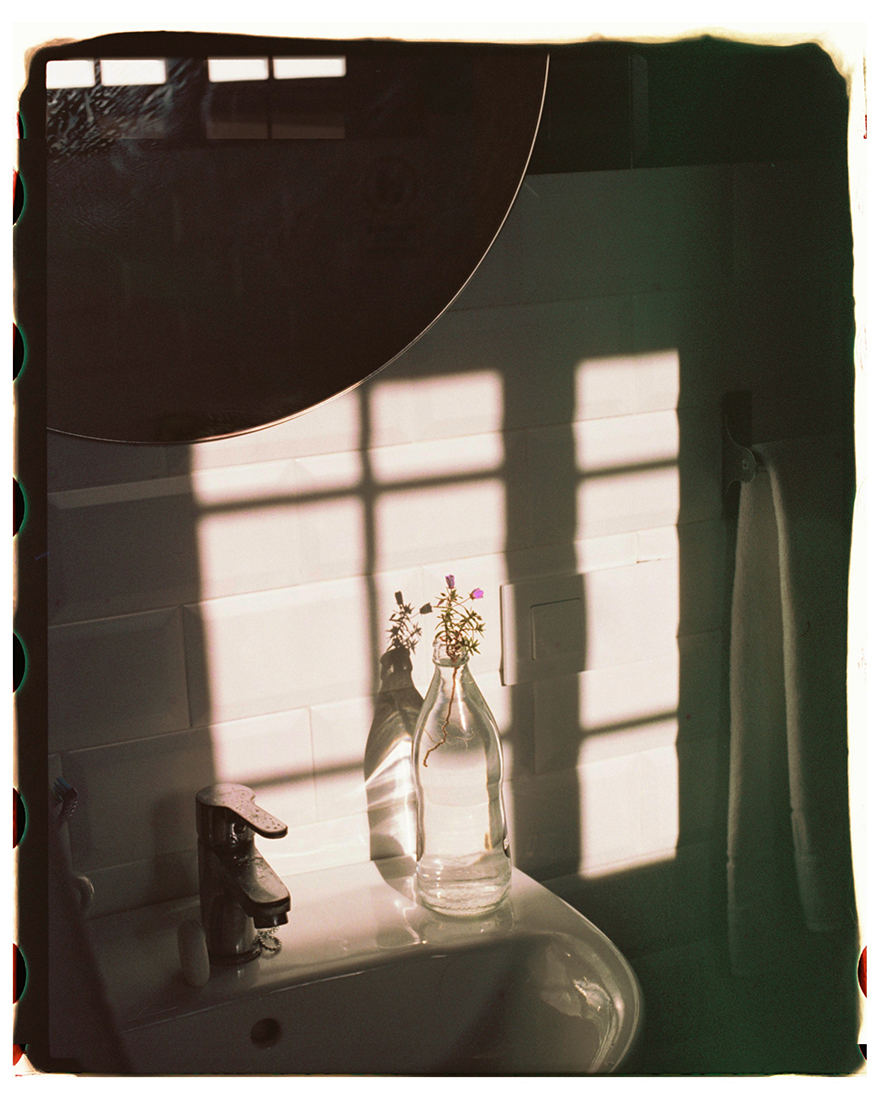
I approach light almost obsessively, but also intuitively. I’m very inspired by cinematic lighting—like the work of Christopher Doyle or Marcell Rév—how they turn something mundane into something dreamlike. I love strong contrasts, letting shadows tell as much of the story as the light does.
When I’m printing by hand in the darkroom, I can control every nuance, which allows me to emphasize certain emotional layers. That process lets me be extremely intentional about how light and shadow interact in each image.
You often work in analog formats like 35mm and 120mm film. What draws you to analog photography, and how does it impact your storytelling?
Shooting on film forces me to slow down and truly look. I like the uncertainty of the process—not knowing exactly what I’ve captured until it’s developed. I shoot with cameras like the Mamiya RZ67 Pro II and Nikon F100 or F6, usually with Ilford Delta 400 or HP5 black and white film.
For me, analog photography isn’t about nostalgia; it’s about presence and commitment. I also print manually in the darkroom, and that final step completes the story—each print becomes unique, part of the narrative itself. I like that imperfections remain, that there’s a physical trace of the process.
And perhaps most importantly, analog fits how I see: I’m not trying to stage or control everything—I’m trying to witness and translate the beauty of the unspectacular.


Cinema, music, skateboarding, and surfing all influence you as “visual poetry.” Can you give an example of how these inspirations manifest in a specific series or image?
In one of my recent series about the traditional jábega boats in Málaga, I found myself drawn to the same kinds of movements, rhythms, and visual energy you find in skate or surf culture. There’s a tension between the body, the sea, and the waiting. Even though the images are still, they carry a kind of kinetic poetry.
Music also plays a role—I often photograph while listening to certain tracks, and I believe the tempo and emotional tone sneak their way into the rhythm of the images. My work isn’t about performance or spectacle; it’s about small, unguarded moments that say more than words could.
Your compositions often feel cinematic. Who are your main cinematic or photographic influences, and how have they shaped your style?
One of my most important photographic references is Gordon Parks—not just for his visual style, but for his ability to tell stories that are both socially urgent and deeply personal. I also admire Lee Friedlander’s complex view of the everyday, and Jeff Wall’s conceptual and formal precision. Recently, I’ve found a lot of inspiration in Renell Medrano’s work—her intimacy, her softness, and the way she portrays youth and identity really resonate with me.
Cinematically, I’m deeply influenced by directors of photography like Christopher Doyle, Peter Deming, and Marcell Rév. Their use of light and framing creates emotional atmospheres that stay with you. All of these influences have shaped how I compose—my images often feel like fragments from a film scene, yet they remain ambiguous, unscripted, unresolved. I love that space.


How did your background in Art History and drawing inform your editorial and commercial work, as well as your personal projects?
My background in Art History has been incredibly influential—it’s taught me to understand images not just as visuals, but as cultural constructions. On a more technical level, studying painting and drawing trained my eye. I’m always looking for depth, for layers within the frame. I tend to compose using triangular structures or geometric lines of perspective, much like in The Oath of the Horatii.
I’m also deeply inspired by how classical painters used light—studying works by Rembrandt, Caravaggio, or even Hopper has helped me develop a more intentional approach to lighting, whether natural or artificial.
This sensitivity to structure and atmosphere has definitely carried into my editorial and commercial projects as well. Whether I’m working on a fashion story or a personal series, I aim to create images that feel cinematic and emotionally resonant—without relying on heavy staging. Authenticity matters to me more than perfection.
What projects or themes are you most excited to explore next, and how might they evolve from your current focus on melancholic imagery and analog techniques?
Right now, I’m working on a long-term project about jábegas in Málaga—traditional fishing boats that carry deep cultural and emotional weight. It’s a mix of documentary and poetic storytelling, all in analog.
And this October, I’ll be traveling to Vietnam for two weeks with a travel magazine to document rural life and local traditions—a project I’m incredibly excited about. I’ll be shooting on film and focusing on subtle, unguarded moments that reflect everyday life with honesty and beauty.
On the commercial side, I’ve had the chance to shoot campaigns for Dr. Martens, and fashion stories for brands like Prada, Diamond Supply, and Dior. With each of these projects, I try to preserve my personal visual language—balancing aesthetics with emotion, storytelling with spontaneity.
Looking ahead, I want to continue exploring themes like memory, identity, and belonging—still through an analog lens, but with more experimental formats, perhaps through artist books or immersive installations. Always with that same quiet, emotional undercurrent.


