
Interviews
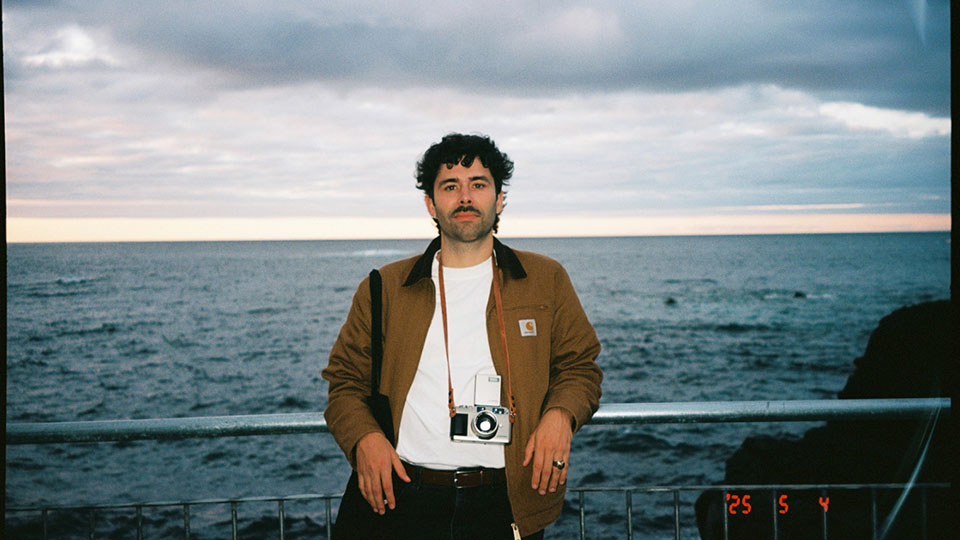
Leo Amaya
Leo Amaya, born in Tenerife in 1995, began his academic journey in 2013 when he moved to Madrid to study Architecture. However, his interest in imagery led him to redirect his studies. In 2016, he started sharing content related to analog photography on social media, marking the beginning of his connection with the medium.
In 2018, he left his Architecture degree to enroll at EFTI School of Photography, and that same year, he began working as a wedding photographer for a company based in Madrid. In 2019, he moved to the Netherlands, where he continued his education and photographic experimentation.
The year 2020 marked his return to Tenerife, where he currently lives and carries out most of his personal photography projects, with the sea as his central theme. Since 2022, Leo Amaya has been working as a wedding photographer under his own brand, using analog photography as his primary means of expression.

As an analog photographer, what do you feel in the moment of pressing the shutter, knowing you won’t see the result until the film is developed?
When I shoot on film, I feel a very strong connection with what I’m doing. It’s almost like entering a state of zen. I have this deep sense of certainty about what I’m capturing, knowing the results will be incredible. In most cases, the photographs even turn out better than I had imagined.
The sea is ever-present in your work: what does the ocean mean to you? Is it inspiration, memory, or something deeper?
For me, the sea is everything. It’s the way I connect, a source of escape, of relaxation, of sport, it becomes all of these at once. Living on an island means I am in constant contact with the ocean, and it has become my greatest inspiration. In the Canary Islands, our bond with the sea runs deep, going back generations, to when many of our ancestors set sail across the Atlantic to Latin America. The ocean is a space for reflection and contemplation, and within that contemplation photography naturally finds its place, capturing how we relate to the sea, its intrinsic beauty, the shifting light on its surface. In many ways, I can say that the ocean is my greatest love.
It was and still is my way to say to the world, ‘I’m here’—this is what I do, it’s where I can materialize my vision to reality, at least at the moment.


Tell us about your trip to South Africa: how does bringing analog photography into the wilderness shape your creative approach?
My trip to South Africa was incredible. Being able to capture the great animals on film, the way it was done in the past, using manual focus and carefully composing each shot, was a deeply enriching experience. In the future, I’d love to repeat that kind of journey, perhaps on a more authentic safari, with an experience that feels even more connected to the place, the people, and nature itself.
When you create, how do you balance visual storytelling, memory, and landscape representation?
For me, the most important aspect of photography is capturing moments of my life: holidays with friends, a day at the beach, those fragments of memory that become timeless once they’re on film. Memory plays a central role in my work. At the same time, I consider myself an obsessive seeker of beauty. It’s something I’m passionate about finding everywhere I go, in every frame I compose. The pursuit of beauty, and the way it reveals itself through the lens, is one of my deepest motivations as a photographer.


You’ve experimented with various film stocks, including Kodak Vision3 500T. How do different film types influence the mood and narrative of your photographs?
For me, consistency is key. When choosing a film stock for a certain scenario or light, it’s important to understand its capabilities. Experimenting with different stocks helps you get a better idea of what to expect in terms of colors, contrast, grain, and how well the latitude holds up in shadows or highlights. I usually go for ISO 200 or 400 in color and 400 or 3200 for black and white. There are many options, but I tend to stick to the ones that give me the look I’m aiming for. I really like motion picture film for stills developed in ECN-2, though I don’t have much access to it and it’s more expensive to develop. I typically only use those cartridges for my Super 8 camera.

You’ve mentioned influences like Todd Hido and Gregory Crewdson—what do you take from their photographic language and how do you adapt it to your own vision?
From Gregory Crewdson, I’ve always been captivated by his cinematic compositions, the way every detail feels staged yet alive, like a frame pulled from an untold story. From Todd Hido, what resonates with me is the sense of uncertainty in his images, that haunting ambiguity that lingers in the viewer’s mind. Recently, however, I’ve been especially drawn to photographers from the Balear Islands, such as Laura Prim, Kate Bellm, Cecilia Renard, or Espe Perelló. What captivates me most in their work is their gaze, always deeply connected to the sea, and profoundly sensitive and beautiful in the way they portray their models. That combination of intimacy and connection to nature inspires me to keep searching for new ways of shaping my own vision.
You’ve mentioned influences like Todd Hido and Gregory Crewdson—what do you take from their photographic language and how do you adapt it to your own vision?
From Gregory Crewdson, I’ve always been captivated by his cinematic compositions, the way every detail feels staged yet alive, like a frame pulled from an untold story. From Todd Hido, what resonates with me is the sense of uncertainty in his images — that haunting ambiguity that lingers in the viewer’s mind. Recently, however, I’ve been especially drawn to photographers from the Balearic Islands, such as Laura Prim, Kate Bellm, Cecilia Renard, and Espe Perelló. What captivates me most in their work is their gaze, always deeply connected to the sea, profoundly sensitive, and beautifully expressive in the way they portray their models. That combination of intimacy and connection to nature inspires me to keep searching for new ways of shaping my own vision.

Multiple exposures and textures often appear in your images—what would your dream project look like if you pushed those techniques further?
My dream look would be something very simple yet profound: warm golden light, a limestone landscape, and calm, still waters. Those elements together embody what I would define as my ideal vision. Even though multiple exposures are no longer the defining feature of my work, they played a crucial role in shaping who I am as a photographer. I still like to return to them from time to time, because they hold a certain magic, a way of seeing that I never want to drift too far from.
You’ve lived and worked between Tenerife and Madrid. How do the city and the sea influence your style differently?
Madrid inspired me in many ways. It’s such a big city, full of people with incredible talent, and being surrounded by that energy pushed me to grow. Tenerife also has a lot of talent, though it often feels like many artists need to leave for Madrid or Barcelona to fully develop their careers. Living between both places has shaped who I am today — in my wedding work, as well as in my editorial and personal style. Right now, I would choose Tenerife, because the sea and the slower rhythm feel essential to me, but I look back on my time in Madrid with great affection. It was a stage of immense growth and discovery.