
Interviews

Ziqian Liu
Born in 1990 in China, graduated from the University of Technology Sydney in 2015, started photography in 2018, based in Shanghai.
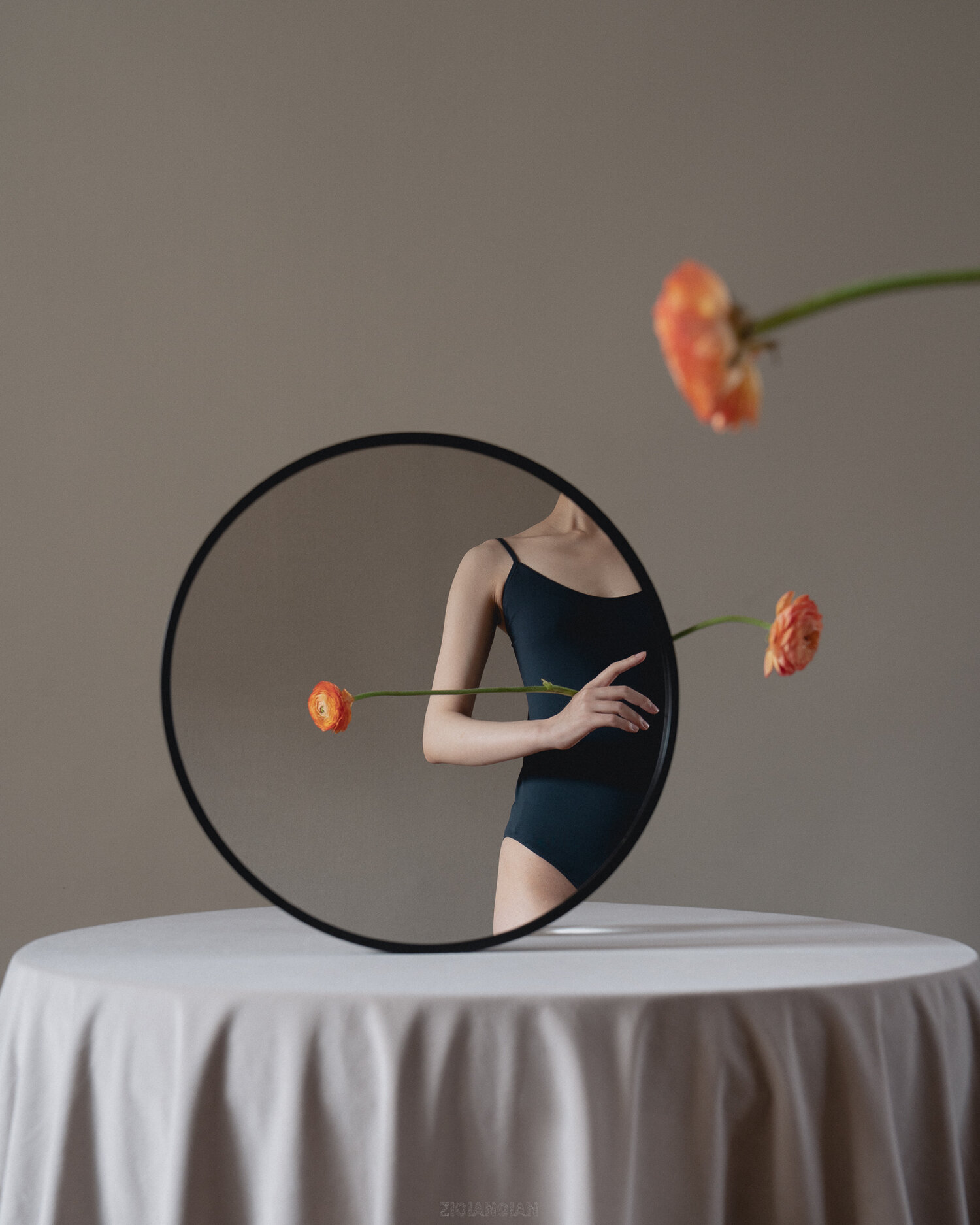
All of her work is a self-portrait. In her work, she combines her body, plants, and mirror images, constantly exploring the balanced state of peaceful coexistence between humans and nature. In terms of visual presentation, she is keen to create quiet images with a sense of rigor and order. Her works intentionally rarely show her face because she wants the viewer to imagine that the body in the picture can be anyone. Different viewers will have different perceptions of her works, which is what she finds most interesting and exciting about photography.

What inspired you to start exploring self-portraiture in your photography?
I first became interested in photography during a graduation trip, where I bought my first camera. At that time, I hadn’t found a job that truly satisfied me and was feeling quite anxious. I wanted to understand myself better and document my daily thoughts and emotions—like keeping a diary, but through images. Gradually, I realized that photography had a calming effect on me. My work became the reward of living with intention; it filled the emptiness I felt and brought me both fulfillment and beauty. That’s why I chose self-portraiture as my creative medium.
How do you select the natural elements, like plants and mirrors, to include in your compositions?
All my props are closely tied to everyday life. Initially, I incorporated flowers and mirrors simply because I liked them—they made life more interesting. But as I continued shooting and reflecting, I began to understand the deeper significance of these elements. They help me explore the subtle connections between myself and my surroundings, illustrating the harmony between humans and nature. I don’t buy props specifically for photography; I use what I already have at home. My house is filled with plants and flowers, and in a way, photography is my way of communicating with them. My creative process is spontaneous and unplanned—I see something, feel a connection, and engage in a silent dialogue with it through my camera.
My work became the reward of living with intention; it filled the emptiness I felt and brought me both fulfillment and beauty.

Can you describe your process for creating such meticulous and serene images?
When shooting, I first connect my phone to my camera, then set up the scene and adjust the props. Finally, I try to blend myself into the composition. Throughout the process, I see myself as a living still life, a supporting element that completes the atmosphere rather than the central focus. Once the general composition is set, I begin fine-tuning my posture and movements, often taking dozens of shots before selecting the one I’m most satisfied with. This process is physically demanding and requires patience, but I deeply enjoy it.
Why is it important for you to keep your face hidden in your self-portraits?
I believe that when a face is visible, the viewer’s attention is immediately drawn to facial features and expressions, potentially overlooking the overall composition. In my work, the figure is not meant to represent “Ziqian Liu” as an individual, but rather a more universal presence. By concealing my face, I allow viewers to project themselves into the image, stimulating their imagination and personal reflections. This approach fosters a deeper emotional connection with the work, making it more memorable rather than something easily forgotten.


Have you received any interpretations of your work from viewers that surprised or moved you?
Some viewers perceive elements of Chinese philosophy, culture, and traditional aesthetics in my work, even though I don’t deliberately incorporate them. In fact, I’ve learned a lot about these cultural aspects through the feedback I receive. As a creator, my process isn’t one-directional—I don’t simply present my work; I also gain valuable insights from the audience’s interpretations.
Many people say my work brings them a sense of peace. After a long, stressful day, they find solace in my images, appreciating the delicate and gentle beauty they convey. Others tell me that my work inspires their own creativity—some recreate my photographs, while others use them as references for paintings. Reading such feedback is incredibly moving; it serves as a source of encouragement and motivates me to continue creating with sincerity.
How does living in Shanghai shape your creative vision and approach?
Shanghai is a vibrant, open, and dynamic city where Eastern and Western cultures merge and interact. There are countless art exhibitions and performances, which I attend whenever possible. I also love walking around the city, observing its diverse architecture and daily life. These experiences undoubtedly shape my personal and artistic perspective, though not in a direct or obvious way. They accumulate over time, like a nourishing breeze, subtly influencing the essence of my work.

Are there any themes or concepts you hope to explore in future projects?
My previous works have primarily focused on body parts and human presence, exploring my relationship with small, everyday objects. In future projects, I hope to expand my perspective, exploring broader themes such as water and fire, the sun and moon—opposing forces and their balance. I also want to deepen my understanding of Eastern culture and aesthetics and integrate these influences into my work.
Do you have any advice for aspiring photographers who want to create meaningful, personal work?
I would encourage them to experiment freely, without restricting their creative impulses. Follow your heart and let your vision unfold naturally.

